
Has foreign intelligence taken over job web sites?
Many "geopolitical risk analysis" positions look like ads for spies


One of the scandals I have been waiting for, but which has not yet occurred, is the one in which the U.S. government determines that a foreign intelligence agency (or, more likely, several of them) have been using well-known employment web sites to recruit unwitting assets in the United States, especially in and around Washington, DC. If these sites don’t do a better job of policing what they post, this seems inevitable to me. I wonder what will happen to some of them when it does.
I began thinking about this a few years ago. After an international speaking engagement, someone claiming to represent a foreign energy/climate-oriented firm reached out to me by email to ask about hiring me as a consultant to write analytical papers on timely issues of interest to their clients. I asked for more information.
What caught my attention was that the recruiter didn’t want work based on public information that “anyone could find on the internet,” but instead on private sources drawn from my network of contacts. A HUGE red flag. Other red flags included deflecting suggestions for video or phone calls, refusing to disclose anything about the clients seeking these reports, proposing a process through which I would respond to and conduct additional research if I received follow-up questions, and promising escalating payments based on the quality of my work. These are exactly the things that a foreign intelligence agency would propose to a source.
After checking with a more experienced friend to be sure that I was not being either paranoid or vain (after all, who doesn’t want to imagine being a spy recruitment target?), I turned down the offer and handed over my correspondence to the FBI. I hope that someone investigated this.
Since that time, I have been increasingly attentive to posts for “geopolitical risk analysis” on job web sites, many of which are posted by LLCs that cannot be readily identified or assessed due to their size and legal structure. The COVID and post-COVID remote work environments facilitate this too.
At one point, after seeing a very suspicious looking post, I wrote to customer service at a particular web site to explain my concern. The company responded to this by temporarily suspending my ability to apply for work, which I wasn’t looking to do anyway. Shortly after that, I raised the issue with a journalist friend. That didn’t go anywhere either. So, if there are any intrepid counterintelligence officers or investigative journalists out there, I hope you might read this and look into it. I bet you will find something.
To give an idea of what I am talking about, I am sharing a screenshot of something that looks unusual to me. Note that I am describing it as “unusual,” meaning that I would suggest closer scrutiny, and not describing it as “suspicious,” “illegal,” or “dangerous.” I am not a lawyer, prosecutor, or investigator and am not accusing anyone (including the hosting web site or the poster) of anything. That said, if I read something like this, I would not apply. Conversely, if I were running a legitimate company, I would be more careful about what I post.
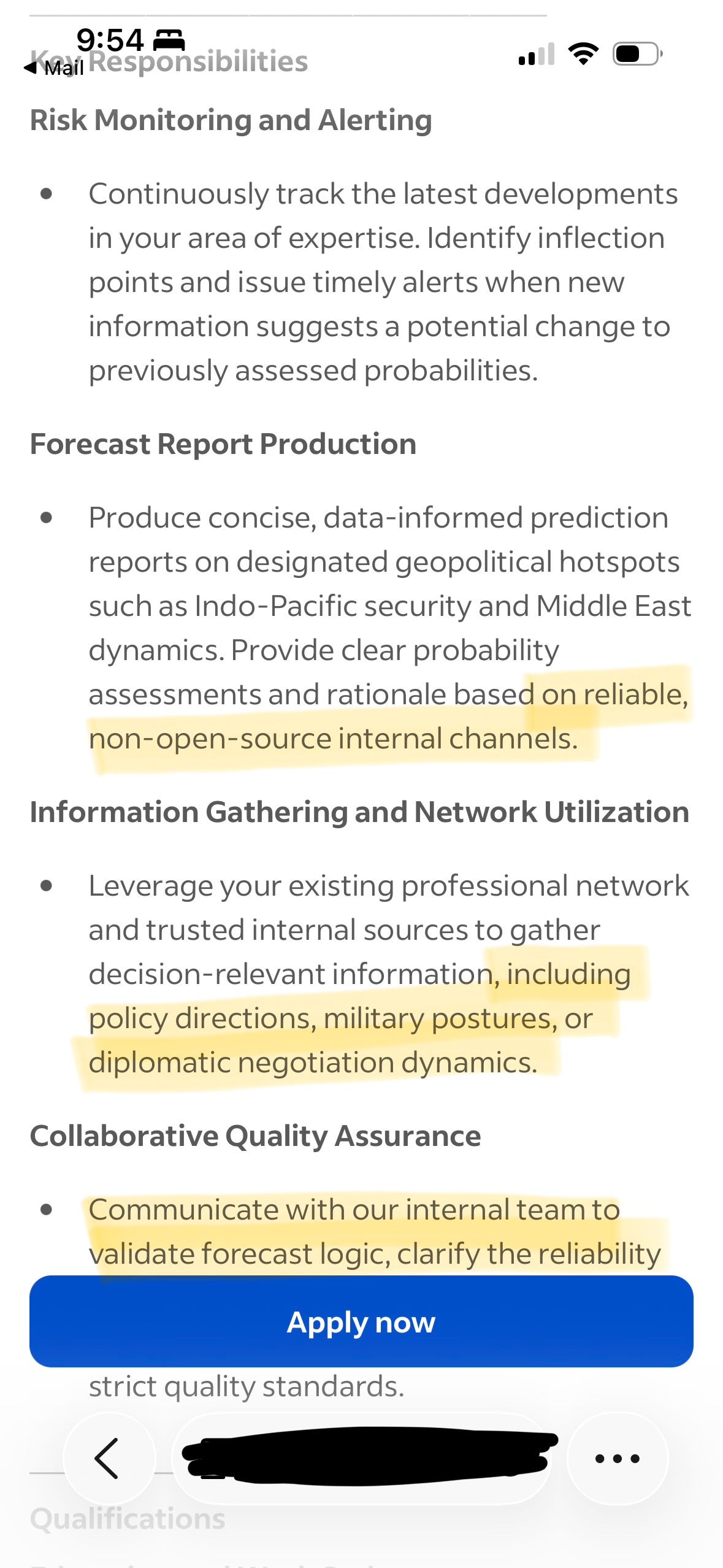
Take a look at what I have highlighted. They want information from “non-open-source internal channels.” They want information on “policy directions, military postures, or diplomatic negotiation dynamics.” And they want the person in the job to explain why they think their sources are reliable. (The “Аpply now” button is covering some of this—trust me.)
There is no doubt that information like this could be of interest to investors or other possible commercial clients. Yet they probably could not use it and legitimate investment advisory firms would likely stay far away from requests like this. Why? Ask ChatGPT, Claude, Perplexity, or even Google “can investors use non-public information?” The short version is maybe, but that there is also a good chance that you could be arrested and charged with violating securities laws. So even if you are not applying to work with a nest of online spies, there is a significant possibility that you are trying to get involved in something illegal.
My general attitude toward the internet and tech companies is one of libertarian permissive tolerance. But the foundation for this attitude on my part—and, I expect, on the part of many in American society—is that these firms will effectively police themselves. Some of our social media companies, especially Meta/Facebook, have paid a steep price for failing to do that and continue to face pressure for tighter legislative or regulatory restrictions on their operations. Will the job sites be next?